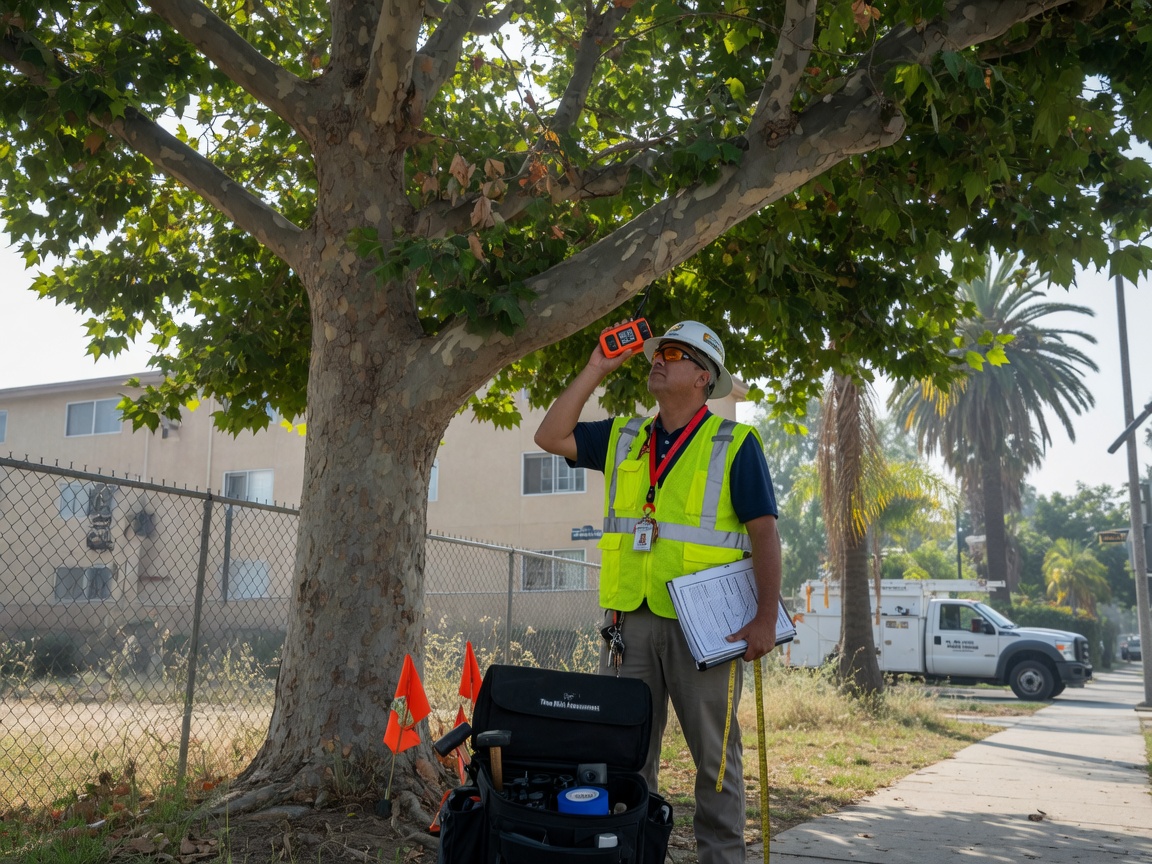
Tree risk assessment begins with a close look at canopy balance, trunk lean, and root flare condition. In El Monte’s warm Mediterranean climate, hot dry summers followed by occasional winter rains can leave eucalyptus and pine trees with hidden decay pockets that only become obvious after a branch drop. Properties in South El Monte and around Arroyo High often sit on older lots where irrigation lines run close to trunks, creating soft spots that invite root failure during the first strong Santa Ana wind event.
Assessors check for included bark, cracks along the main stem, and soil heave that signals instability. Near El Monte City Hall and the Historical Museum, many mature trees were planted decades ago when street grades were different, so root plates now sit partially exposed. A thorough evaluation notes clearance to power lines, proximity to sidewalks, and any history of previous pruning cuts that may have sealed in decay.
Written reports include prioritized recommendations such as crown reduction, cable installation, or removal when the lean exceeds safe limits. Homeowners in Baldwin Park and West Covina frequently request assessments after seeing neighbor trees fail during mild winter storms, because the same soil and wind patterns affect the entire San Gabriel Valley corridor.
Documentation also covers target rating—what the tree could hit if it fails—so owners understand whether a leaning tree over a driveway poses higher risk than one over open lawn. This level of detail helps residents in North El Monte decide whether monitoring or immediate action is warranted.
Technician insight
In El Monte, the thing that catches most people out with tree risk assessment is how our mild winters and steady irrigation keep roots shallow on older lots in South El Monte and around Legg Lake, so a tree that looks solid from the street can shift after one good rain.
Leaning pine near driveway
A homeowner in North El Monte noticed a pine leaning toward the garage after winter rains. Inspection found soft soil at the base and a cracked root flare from nearby sprinkler overspray. We recommended crown reduction and soil amendment rather than removal. The tree stabilized and the owner avoided a potential garage strike during the next wind event.
Tree Risk Assessment Services We Offer
✓Visual Tree Assessment
Walk-around inspection that flags obvious defects like cracks, deadwood, and lean before they become hazards in El Monte wind events.
✓Decay Detection with Resistograph
Drilling resistance mapping to locate internal voids without cutting the tree, useful for older specimens near Legg Lake.
✓Root Collar Excavation Check
Careful soil removal around the base to reveal girdling roots or decay hidden by irrigation practices common in South El Monte yards.
✓Target Assessment Report
Rated evaluation of what a failing tree could strike, including structures, sidewalks, and overhead lines in Downtown El Monte.
✓Post-Storm Reassessment
Follow-up inspection after heavy rain or wind to confirm no new cracks or root movement developed on previously evaluated trees.
Tree Risk Assessment Cost in El Monte, CA
| Service | Typical Range | What Affects It |
|---|---|---|
| Basic visual assessment, 1-3 trees | $175–$325 | Flat residential lots in El Monte |
| Resistograph decay mapping | $125–$250 | Per tree, added to visual assessment |
| Root collar excavation | $200–$450 | Depends on depth and irrigation interference |
| Written report with photos | Included | Standard with every assessment |
Ranges are typical for El Monte, CA and confirmed with an exact written quote before any work starts.
How it works
- 1
Site Walk And History Review
Owner describes any past issues while we note property layout, nearby structures, and irrigation patterns.
- 2
Detailed Inspection
Climbing or bucket access to examine upper crown, trunk, and root zone for defects specific to local soil and wind exposure.
- 3
Risk Rating And Report
Findings are scored by likelihood and consequence, then delivered with clear action steps and photos.
- 4
Follow-Up Options
Discussion of monitoring schedules or immediate work needed before next seasonal weather pattern arrives.
Pricing
Most single-property assessments fall in the mid-hundreds; larger sites or advanced tools increase the range.