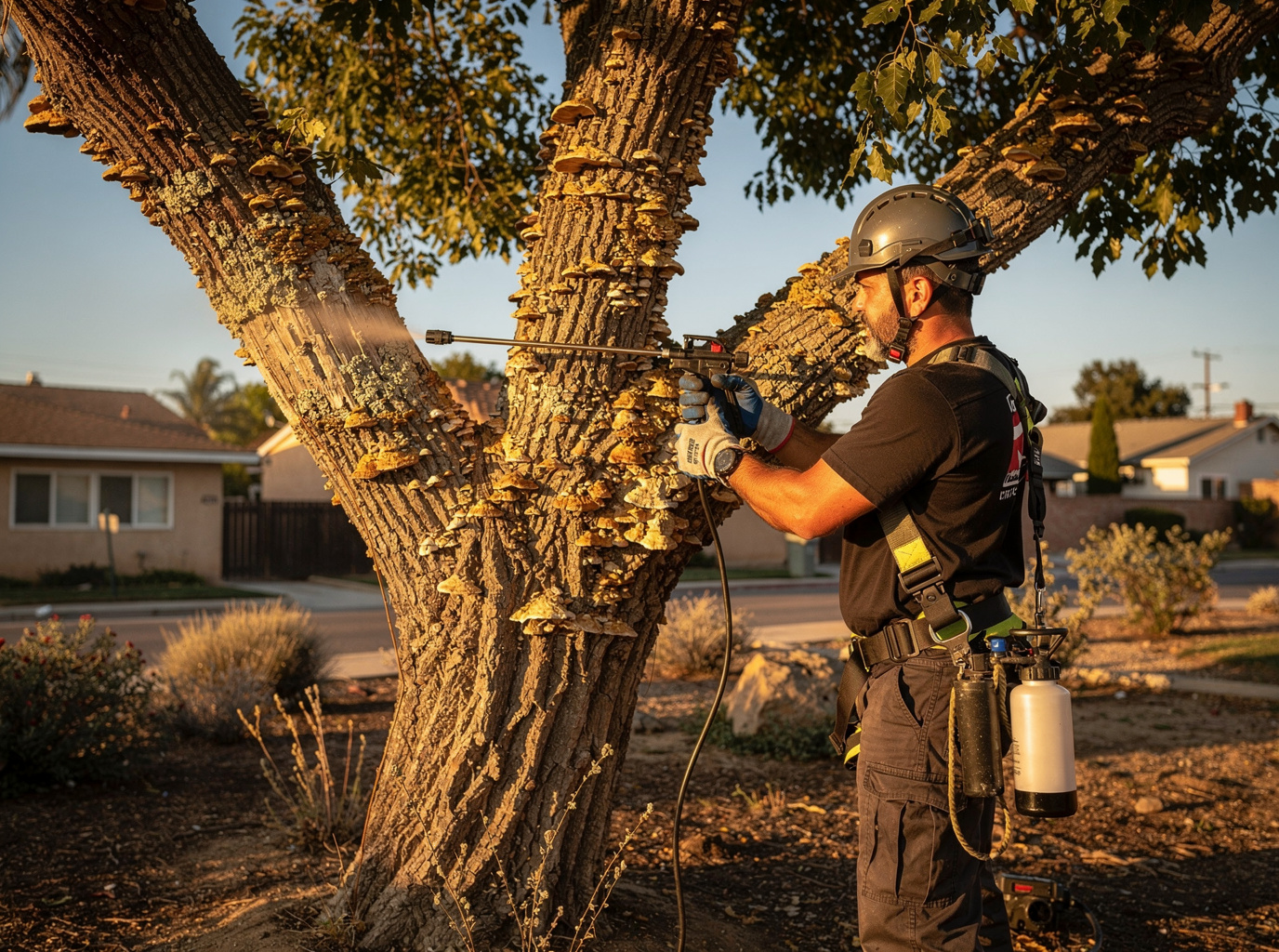
El Monte’s hot summers and mild winters create conditions where fungi such as Armillaria and anthracnose thrive in the compacted soils common around older housing stock in North El Monte and around Legg Lake. Treatment begins with soil aeration and targeted systemic fungicides applied at the root flare rather than surface drenches that wash away during rare winter rains. Crews working near El Monte City Hall often encounter trees stressed by reflected heat from pavement, requiring higher rates of phosphorous acid products to suppress cankers before they girdle trunks.
In South El Monte and Baldwin Park, clay-heavy soils retain moisture longer, encouraging Phytophthora spread between neighboring yards. We use labeled products like mefenoxam injected via soil probes at 12–18 inch depths to reach feeder roots without runoff into storm drains. Edge cases include fungus on heritage oaks near Arroyo High where permits from Los Angeles County are required before any root-zone work; skipping this step risks fines and tree loss. Homeowners in West Covina sometimes confuse drought scorch with fungal leaf spot, leading to unnecessary spraying that harms beneficial mycorrhizae already weakened by the region’s low rainfall.
Follow-up visits scheduled six weeks after initial application allow us to monitor new growth and adjust rates based on actual canopy response rather than calendar dates. This matters in mild-winter years when some pathogens remain active into February.
Technician insight
In El Monte the thing that catches most people out with tree fungus treatment is how mild winters let root rot stay active in the heavy clay soils around older homes in North El Monte; homeowners often water too much in winter thinking the trees are dormant, which keeps the pathogen thriving right up to the first hot spell.
Oak root rot near Legg Lake
A coast live oak in South El Monte showed thinning canopy and mushrooms at the base. Soil probe revealed compacted clay holding moisture from nearby irrigation. We aerated the root zone and injected phosphorous acid; six weeks later new growth appeared and the mushrooms stopped forming.
Tree Fungus Treatment Services We Offer
✓Root Rot Treatment
Systemic fungicide injection and soil aeration to control Armillaria and Phytophthora in mature trees common on older lots in North El Monte.
✓Anthracnose Control
Foliar and soil applications timed to El Monte’s spring growth flush to protect sycamores and oaks from leaf blight that spreads during warm, humid periods.
✓Canker Suppression
Targeted trunk and branch treatments for Cytospora and other cankers that develop on drought-stressed trees near paved areas like Valley Boulevard.
✓Soil Drench for Phytophthora
Deep root-zone applications that reach feeder roots in clay soils typical of South El Monte without surface runoff during winter rains.
✓Oak Fungus Prevention
Preventive phosphite treatments for coast live oaks around Legg Lake and the El Monte Historical Museum where sudden oak death pressure exists from nearby infected areas.
Tree Fungus Treatment Cost in El Monte, CA
| Service | Typical Range | What Affects It |
|---|---|---|
| Initial site inspection and diagnosis | $75–$150 | Higher when multiple trees or ladder access near power lines is required |
| Root rot treatment per mature tree | $250–$550 | Depends on trunk diameter and soil type; clay soils in South El Monte often need extra aeration |
| Foliar anthracnose spray | $180–$350 | Per tree; two applications usually needed during spring flush |
| Follow-up visit and re-treatment | $150–$300 | Waived if no reapplication is required |
Ranges are typical for El Monte, CA and confirmed with an exact written quote before any work starts.
How it works
- 1
Site Inspection
Walk the property in Downtown El Monte or North El Monte to identify symptoms, map affected trees, and note soil compaction or irrigation patterns.
- 2
Lab Confirmation
Collect samples for identification of the specific fungus before any product selection, avoiding misapplication that wastes time in our short treatment windows.
- 3
Treatment Application
Apply chosen fungicides via injection, soil probe, or foliar spray while protecting surrounding hardscapes and avoiding drift toward neighboring properties in dense neighborhoods.
- 4
Follow-Up Monitoring
Return after six weeks to assess canopy response and reapply if new growth shows continued infection, especially after summer heat waves.
Pricing
Pricing varies by tree size, access, and whether lab confirmation is needed; most single-tree treatments fall between initial assessment and full application.